
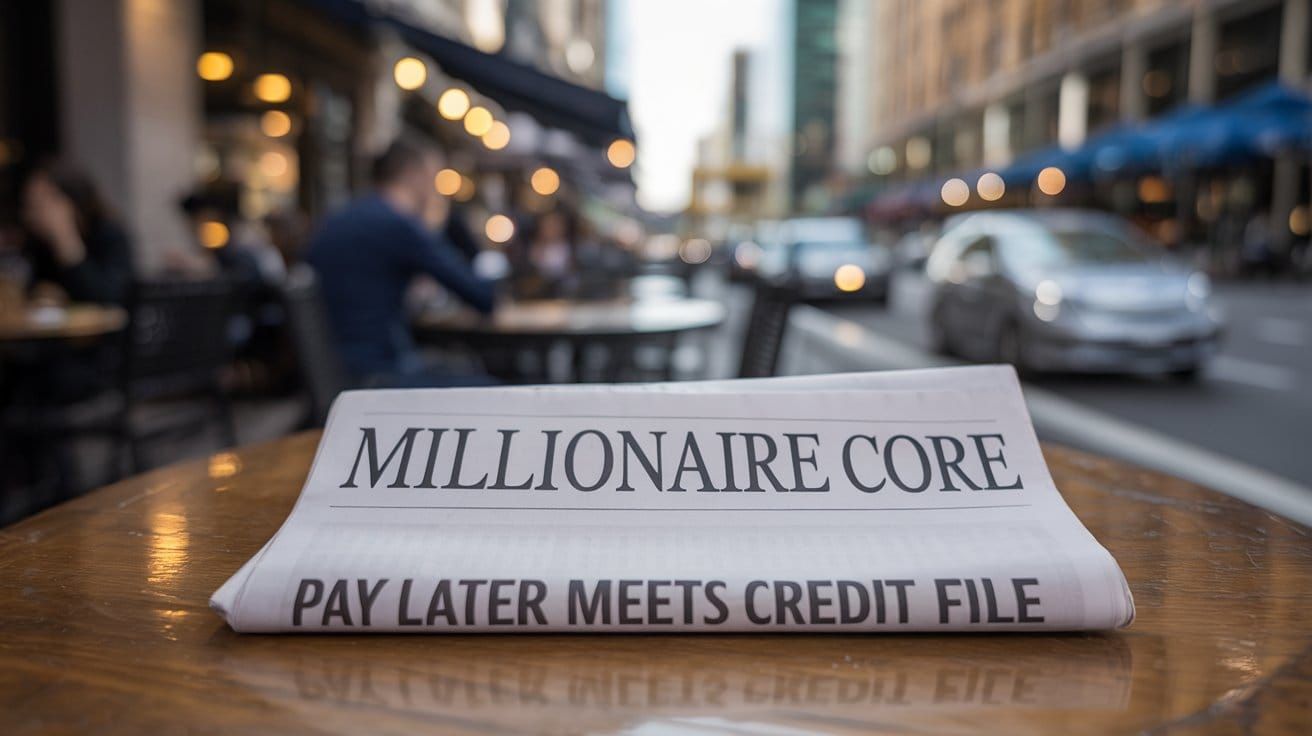
Buy now pay later used to be invisible. You split a purchase into four payments, nobody reported it anywhere, and a missed payment cost you a late fee and nothing else. That has been quietly changing, and heading into the heaviest borrowing season of the year, a lot of shoppers are about to find out the rules moved.
Sponsored by Porter & Co.
Trump’s Final Gambit
President Trump just returned from Beijing with the most powerful business delegation in American history…
Elon Musk. Nvidia’s Jensen Huang. Apple’s Tim Cook. Treasury Secretary Scott Bessent and the CEOs of CitiBank, BlackRock, and Goldman Sachs.
The media covered the handshakes, the state banquet, the 200 Boeing jets that China agreed to buy.
But, of course, they missed the real story.
Because while the world watched the pageantry, I believe something far more consequential was being negotiated behind closed doors.
Trump wasn't in Beijing to talk about soy beans. He was there to secure America's hemispheric grip on the most critical resource of the 21st century.
So precious, he desperately needs it to reverse the decline of the U.S. dollar. And so powerful, Vladimir Putin has said whoever controls it will "become the ruler of the world."
No one seems to be asking why Trump brought the CEOs of the world's most powerful technology and energy companies onto Air Force One.
Or what those men – who between them control more capital than most nations – were really there to negotiate.
And nobody has connected what went down in Beijing to a landmark pact signed by 13 nations in Washington just months ago – a pact designed to cut China out of the biggest investment wave in financial history.
And what I've uncovered could impact everything about your financial future – from your stock portfolio to your retirement account to the purchasing power of every dollar you've saved.
In my new documentary, I expose exactly what Trump is really doing, how he has completely bypassed Congress to make it happen – and the five mission-critical assets sitting at the heart of his shocking, $3 trillion gambit.
Good investing,
Porter Stansberry
What Actually Changed
FICO built scoring models that read short installment loans, including the four payment kind, and weigh patterns such as several of them opened in quick succession. Those models exist and lenders are beginning to adopt them.
Separately, and more importantly, some providers now report to the bureaus. Affirm sends payment data to Experian and TransUnion, so those loans appear on your file and behave like credit. Klarna and Afterpay currently do not report to the major bureaus, so their payment history stays invisible.
That split is the part to understand. Two purchases made the same afternoon on two different apps can have completely different consequences.
The Asymmetry Is Not In Your Favor
Where reporting happens, a missed payment now damages a score the way any other late payment does. Where reporting does not happen, on time payments build nothing.
So the downside is being reported and much of the upside is not. That is a bad trade to walk into without knowing it, especially in a season when the average shopper is planning to spend $950 and 39% still intend to use these services.
Why Stacking Is The Real Risk
The structural problem with four payment plans has never been the interest. It is that each one is small enough to approve without thought, and they do not appear together anywhere. A household can be carrying six of them, due on six different dates, and have no single screen that shows the total.
Scoring models that flag rapid sequential openings exist precisely because lenders noticed the same thing.
Final Take
Before the season starts, do an inventory. Open each app you have used, find the active plans, and write down the total owed and the due dates in one place. Most people who do this are surprised by the number, which is the point.
Then set the payments to autopay from the account the money is actually in. Almost every BNPL default is a timing failure rather than an affordability failure, and timing failures are now going on your credit file at some providers.
And if you are choosing between a card and a four payment plan this year, know what you are choosing. A card charges interest and reports everything. The plan charges nothing and may report only the mistakes.
Free is not the same as harmless.
Is This the Next $110B Coffee Giant? (Sponsored by Green Coffee Company)
I called Tesla in 2019. Here’s What I’m Buying Now (Sponsored by InvestorPlace Media)
Dimon and Gates issue warning about Musk’s Next Launch (Sponsored by InvestorPlace Media)
Meet the Wall Street Veterans Behind Colombia's #1 Coffee Producer (Sponsored by Green Coffee Company)
Live demo of Elon Musk’s 70X AI agent (Sponsored by Brownstone Research)
Disclaimer
The content in this email does not constitute an offer or solicitation to buy or sell any financial instrument. All commentary is general in nature and is not directed at any individual investor.
Written by Deniss Slinkins
Millionaire Core