

Electricity is up about 4.4% over the past year and piped gas about 5.0%, and the explanation on offer is usually about fuel, or data centres, or the weather. For most households none of those is the mechanism. A regulated utility cannot raise your rate by deciding to. It has to file a case, argue it in front of a state commission, and be granted the increase. This year it is filing more of them than at any point on record: about $4.5 billion of requests in the third quarter alone, and roughly $23.1 billion so far this year.
Sponsored by Freedom Financial Research
Thanks to the IRGC, we now have 15 positions in P.I.P.
Editor’s Note: Before writing Rich Dad Poor Dad, Robert Kiyosaki hauled crude across the Pacific as a deck officer for Standard Oil. When Iran shut down the Strait of Hormuz and tanker rates went ballistic, he knew exactly where to look. P.I.P. now includes a tanker operator earning $51,870 a day on a $10,800 breakeven and pays 74 times a year at a blended yield of up to 8-10%. Click here to watch his short video or read more below.
Nobody wants war. Least of all me.
I flew helicopter gunships in Vietnam.
But I also learned that war is the ultimate stress test.
When there’s conflict, the only things worth owning are the things people can’t live without.
So when Iran closed the Strait of Hormuz, I didn’t panic. I repositioned.
While everyone was fixated on $4.50 gas, I was looking at who was collecting the extra cash. The answer: the people who own the ships.
One tanker operator’s vessels are now earning $51,870 a day, up from $21,000 before the war. Its breakeven is $10,800. That’s not profit. That’s a bonanza.
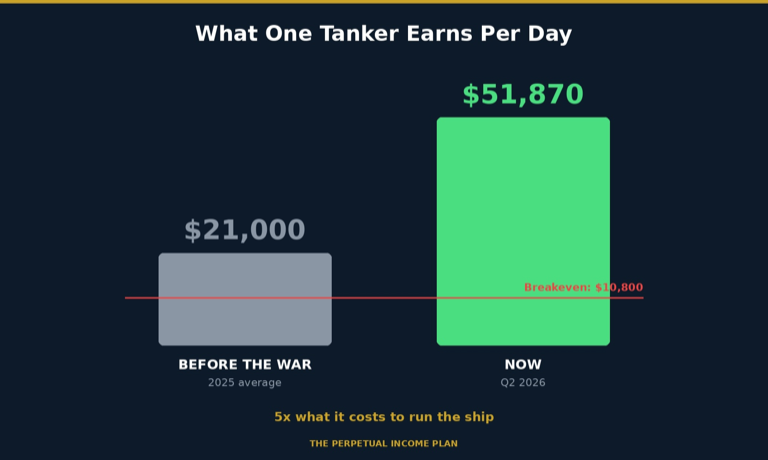
That’s why I’ve now added this tanker to the Perpetual Income Plan, or P.I.P. for short.
And I’ve added four more positions just like it.
P.I.P. went from 42 payouts a year to 74 and I made a new video showing you what’s been added and why this portfolio is more impressive now than it's ever been.
Sincerely,
Robert Kiyosaki
Editor, The Kiyosaki Letter
P.S. The tanker operator in P.I.P. just doubled its quarterly payout. $51,870 a day. Breakeven: $10,800. See all five new positions here.
What A Rate Case Actually Is
A utility submits the revenue it says it needs. Staff, consumer advocates and intervening parties argue against the number. An administrative judge usually recommends something lower, and the commission votes.
The gap between the ask and the result is where household money lives. In Arizona, Tucson Electric Power amended its request to about 9.8%, roughly $13.50 a month for a typical residential customer, and the judge recommended 9.4%, roughly $12.93. The commission takes it up on November 17.
The requests themselves are blunt once translated. Oklahoma Gas and Electric asked for $395 million, about $23.88 a month for residential customers. Potomac Edison in Maryland asked for $52.8 million, about $9.47 a month. In Wisconsin, We Energies sought a residential increase in the range of 14% to 15%, which is $14 to $15 a month next year with more behind it.
The Part Most People Miss
These proceedings are public, and in every state a residential customer may file a comment without a lawyer, usually by email or an online form on the commission's own site.
Comments are read, counted and cited. They will not by themselves defeat a filing, and anyone promising otherwise is selling something. They do affect the margin, and the margin in a billion dollar case is measured in dollars a month across millions of households.
The second thing most people miss is that interim rates are often already in effect while a case is pending. In Oklahoma, residential customers are paying roughly $11 a month in interim increases on a case the commission has not finished. If the final number comes in lower, the difference is refunded. If you are not watching, you will not notice either direction.
Final Take
Three things are worth an hour before winter bills arrive.
Find out whether your utility has a case open. Search your state's name with the words public utility commission or corporation commission, and look for the docket list. The filings state the requested increase in dollars per month for a typical residential customer, which is the only figure that matters to you.
File a comment if one is open. It takes ten minutes, it is free, and the deadline is published on the docket.
And separately from any of that, ask your utility directly about three programmes that exist almost everywhere and that people assume they do not qualify for: budget billing, which flattens the winter spike without reducing the total; the low income assistance programme, whose income limits are considerably higher than most people expect; and a free or subsidised home energy audit. The third of these is the only one that reduces the bill permanently rather than rearranging it.
The AI bottleneck is chips. (Sponsored by American PowerGen)
The same setup just hit 70 million 401(k)s (Sponsored by Omnia Research)
5 Guaranteed Reasons the AI Boom's Biggest Winner Won't Be a Chip Company (Sponsored by Qnetic)
It could power the next hot IPO on Wall Street (Sponsored by Brownstone Research)
A guide to America’s new money (Sponsored by Porter & Co.)
Elon Musk’s 4th Wealth Window Set to Open by November 30 (Sponsored by Brownstone Research)
Warsh’s rate hike just made this ticker even more important… (Sponsored by Omnia Research)
Disclaimer
The content in this email does not constitute an offer or solicitation to buy or sell any financial instrument. All commentary is general in nature and is not directed at any individual investor.
Written by Deniss Slinkins
Millionaire Core