
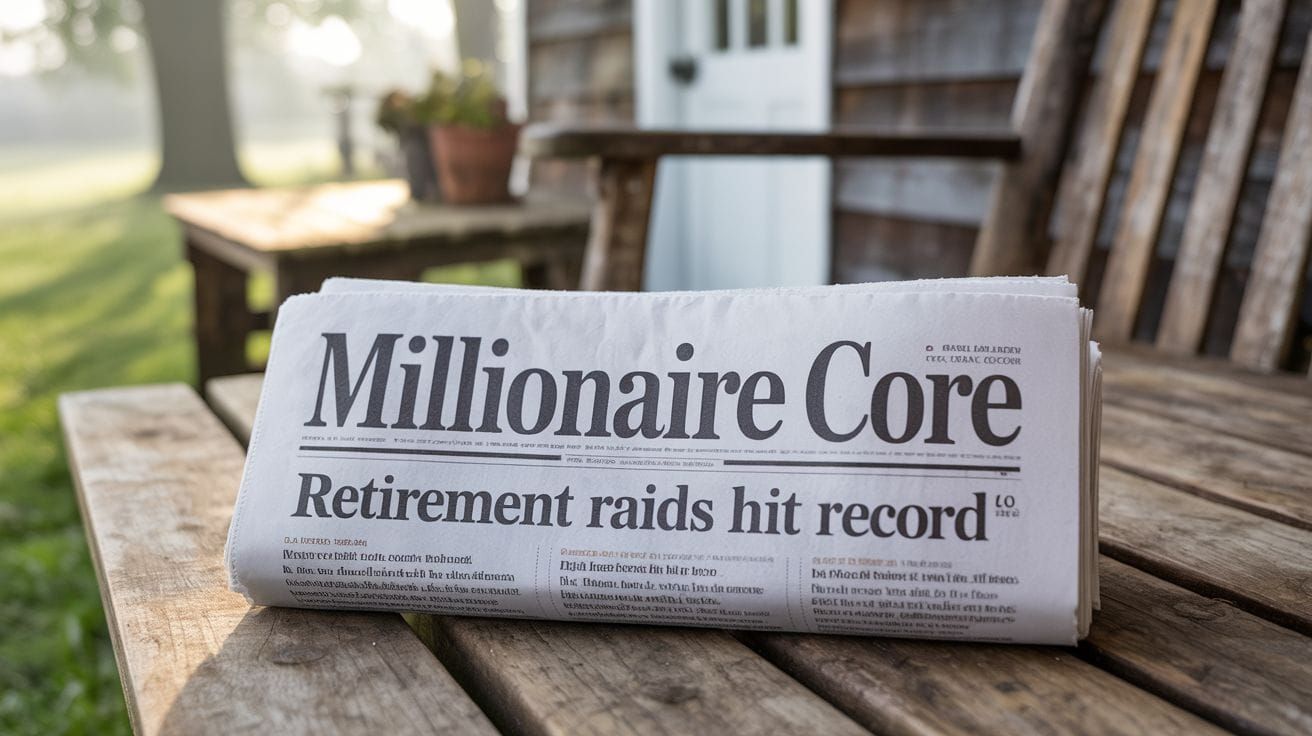
The average Vanguard 401(k) balance ended last year at $168,000, up 13%, carried there by a strong stock market. In the same year, 6% of participants took a hardship withdrawal, the highest share Vanguard has ever recorded and up from 5% the year before. Both facts describe the same accounts. One is about the market. The other is about the household that owns it.
Sponsored by Brownstone Research
What to do if you missed out on SpaceX
Editor’s Note: Jason Bodner spent two decades on Wall Street. He placed huge trades for the biggest funds and richest people on Earth. Along the way, he built a tool that does one thing. It catches big firms quietly buying a stock — before the rest of the market wakes up. Right now, it has flagged something odd. BlackRock, Goldman Sachs, and Vanguard are sneaking cash into two overlooked AI stocks. And they’re doing it before the November 3 election. Click here for the details or read more below.
Dear Reader,
If you feel like you’re always one step behind in the market…
And even when AI stocks are soaring…
Or energy stocks spiked during the Iran War…
Or the next great tech company goes public in an IPO…
You still can’t seem to get ahead.
Now is your chance.
Using our proprietary indicator.
You can see where Wall Street’s going.
Before the stock moves…
And now, you can see which stocks the biggest firms on Wall Street…
Like BlackRock, Goldman Sachs, and JPMorgan…
Are quietly loading up on right now.
There’s two in particular that stand out.
I believe these giant institutions are scooping up as much of these stocks as possible…
Before November 3.
Why?
Regards,
Jason Bodner
Founder, Outlier Intel
P.S. Our backtest shows 85% of the stocks my system flags have gone up.
In fact, the average stock doubled…
And that includes the losers.
Click here to see what this tool says now.
What a Hardship Withdrawal Actually Is
This is not a 401(k) loan, which is repaid with interest to yourself. A hardship withdrawal is a permanent removal, allowed only for a defined list of emergencies, and it is treated as ordinary income in the year you take it. Under 59 and a half, it usually carries a 10% penalty on top.
The median withdrawal was $1,900. That figure is worth sitting with. People are not looting their retirement accounts for something extravagant. They are pulling out roughly two thousand dollars, accepting a tax hit and a penalty to do it, because they have run out of other options.
The Reasons Tell the Story
Thirty-six percent of hardship withdrawals were to avoid foreclosure or eviction. Another 31% were for medical expenses. Tuition accounted for 13%, and home repairs 11%.
Two thirds of the total, then, is housing and health. Those are not discretionary categories and they are not small-dollar categories. They are the two lines that have inflated hardest for a decade.
Why Rising Balances Make It Worse, Not Better
There is an uncomfortable mechanism here. When account balances go up, the money looks more available. A balance that reads $168,000 feels like it can spare two thousand in a way that a balance reading $60,000 does not.
But the two thousand is not the cost. Money removed from a tax-deferred account stops compounding permanently, and the replacement contribution comes out of after-tax income later, if it comes at all. For someone in their fifties, a withdrawal taken now is money that had a decade or more of growth still ahead of it.
Final Take
If you are anywhere near this decision, the order of operations matters more than the decision itself.
A 401(k) loan, where your plan allows one, avoids both the tax and the penalty as long as you stay employed and repay it. Most plans permit borrowing up to half the vested balance. That is not free money and it carries a real risk if you lose the job, but it is a materially better instrument than a hardship withdrawal for the same dollar amount.
For medical bills specifically, hospital financial assistance policies are federally required at nonprofit hospitals and are routinely not offered unless you ask. For housing, servicers have forbearance and modification options that most borrowers never inquire about until after they have already drained something.
The record balance and the record withdrawal rate are not a contradiction. They are what it looks like when asset prices and household budgets stop moving together.
Luke Lango: My #1 Space Stock to Buy ASAP (Sponsored by Investor Place)
The secret of America’s new money (Sponsored by Porter & Co.)
Like a “B.C. to A.D.” shift in U.S. financial markets (Sponsored by Brownstone Research)
An Opportune Moment in the $110B U.S. Coffee Industry (Sponsored by Green Coffee Company)
Act now before it’s too late (Sponsored by Brownstone Research)
FREE BUY ALERT: 3 stocks to own in 2026 (Sponsored by Ratings Plus)
The scandal that could fund your retirement (Sponsored by Omnia Research)
Written by Deniss Slinkins
Millionaire Core