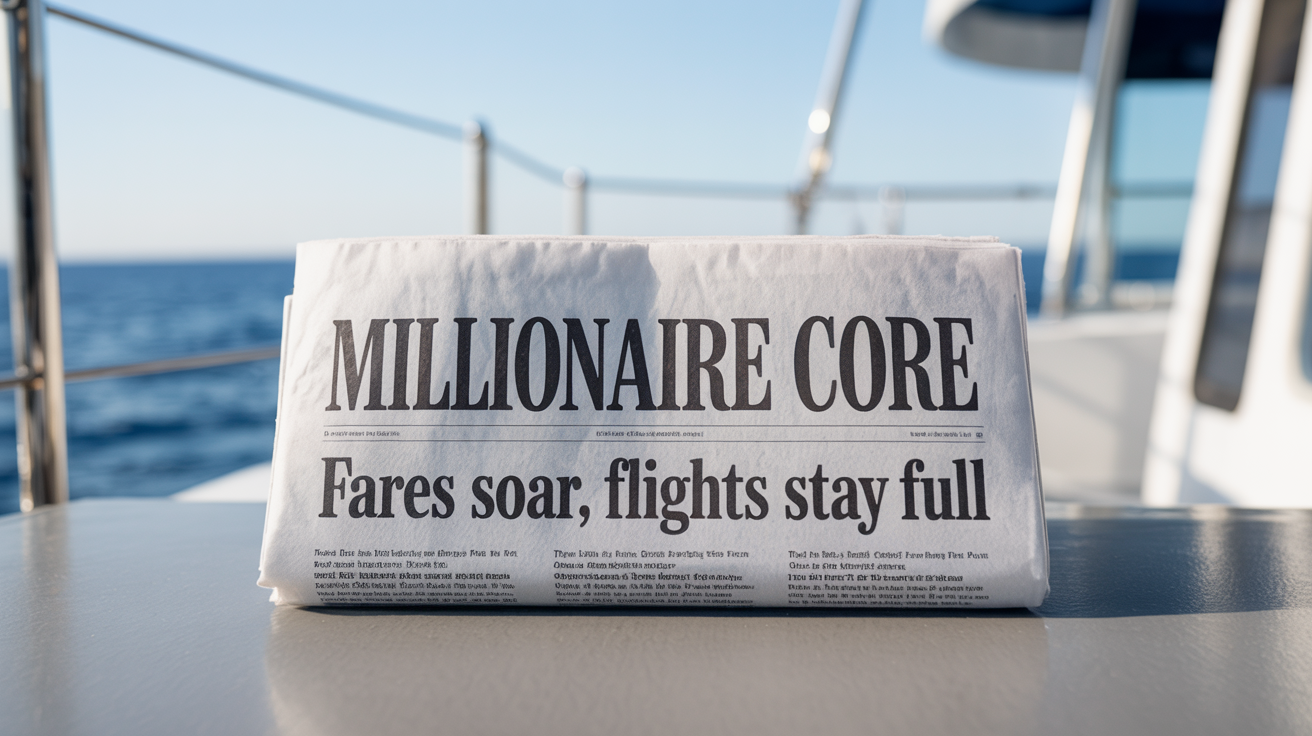
Consumer sentiment has been sitting near record lows for months, and more than half of households say high prices are squeezing their budgets. Airfares just jumped over a quarter in a single year, and planes are still taking off full. Something doesn't add up, unless you look at who's actually buying the tickets.
Editor’s Note: Make time for this today – Porter’s explosive new documentary exposes the President’s plans to replace the U.S. dollar. If you have retirement savings, a stock portfolio, or a family depending on you financially, you need to watch it right now.
In the early 19th century, whale oil was among the most valuable commodities on Earth.
It lit the lamps of America. It lubricated the machines of the Industrial Revolution. Entire coastal economies like New Bedford, Nantucket, and New London thrived because of it.
The scarcity was real. Whales were finite after all – and the expertise to hunt them, process them, and bring the oil to market took decades to develop.
That scarcity underpinned an entire monetary ecosystem.
Then in 1859, Edwin Drake struck oil in Titusville, Pennsylvania.
Kerosene arrived. It was cheaper, more abundant, and much more powerful.
The whalers didn't disappear overnight. The compression was gradual – and then suddenly catastrophic. Within two decades, the whaling industry had effectively collapsed.
The scarcity hadn't disappeared. It had migrated. And the fortunes built on whale oil migrated with it – to the men who understood where scarcity had moved.
This is what a great repricing looks like.
A friend of mine, financial writer Garrett Baldwin, has a phrase for what happens to the people who don't move in time. He calls it the "flooding layer."
The idea is simple – every time the scarcity underpinning an entire industry evaporates, it creates two groups of people:
Those who own the new chokepoint. And those standing in the flooding layer – watching everything they built get washed away.
The brutal truth is that the people in the flooding layer almost never see it coming. Not until the compression is irreversible.
For a more recent example, let’s look at Kodak.
In 1988, Eastman Kodak employed nearly 150,000 people.
It was one of the most valuable companies in America. Its business was built on a form of scarcity that seemed unassailable – the chemistry, the film, the paper, the processing infrastructure required to capture and develop a photograph.
That scarcity evaporated when the smartphone put a camera in every pocket.
Kodak didn't fail because folks stopped taking pictures – it failed because the scarcity that underpinned its entire business model migrated.
In 2012, Kodak filed for bankruptcy.
That same year, Facebook acquired Instagram – a company with 13 employees – for $1 billion. Instagram had captured the value that Kodak lost.
The scarcity had migrated from chemistry to connectivity and the people who understood that got very rich. Those left standing in Kodak's flood plain did not.
Today I’d like to show you that we’re living through another great repricing – one that is already making millions of dollars for those who understand where the scarcity is migrating once again.
To understand what’s unfolding we have to rewind to a secret deal that’s profoundly shaped everything about our lives, for more than half a century.
Travel Prices Are Climbing Fast, Not Slowly
Airline fares are up 26.7% year over year as of May, with premium economy, business, and first-class tickets rising across the board. Hotel prices have been accelerating too, up 5.1% year over year, climbing steadily from 2.1% in March to 4.3% in April to the current pace. This isn't a one-month blip. It's a steady, months-long climb in what it costs to take a summer trip.
Airlines Are Pricing This Way Because Demand Is Actually There
If seats were sitting empty, airlines would be discounting to fill them. They aren't. Planes are still flying full despite the higher prices, which tells you this is a real demand story, not just companies testing how much people will tolerate. Good weather, pent-up reasons to travel, and higher jet fuel costs are all feeding into the pricing, and airlines have the leverage to push fares higher because people are still buying.
This Doesn't Match the Rest of the Household Picture
Here's the tension. Other recent data shows restaurant and electronics spending pulling back, the personal savings rate sitting near a four-year low, and consumer sentiment still depressed by historical standards. Full planes and record airfares alongside a stressed-out household sector usually means the spending is concentrated rather than universal. The travel boom looks a lot less like "the average family is thriving" and a lot more like higher earners continuing to spend freely on travel and experiences while other households pull back everywhere else, including in the sky, where they simply aren't flying as much this year.
Final Take
A headline about full planes and rising airfares sounds like proof the consumer is fine. Read alongside falling savings rates and rock-bottom sentiment, it looks more like evidence of a split economy, where discretionary spending on things like travel is holding up because it's concentrated among people with more room in their budgets, not because the typical household has more breathing room than it did a year ago. If you're planning a trip this summer, the market has room for you. If you're wondering why it feels like everyone else can afford it and you can't, this is likely why.
Written by Deniss Slinkins
Millionaire Core
A Dramatic Acceleration in AI Will Cleave the Stock Market in Two This Summer (Sponsored by Chaikin Analytics)
URGENT: A new type of AI could unleash gains of up to 10,000% (Sponsored by Brownstone Research)
Is This Elon Musk's Next IPO? (Sponsored by Brownstone Research)
A revolutionary new type of AI (Sponsored by Brownstone Research)