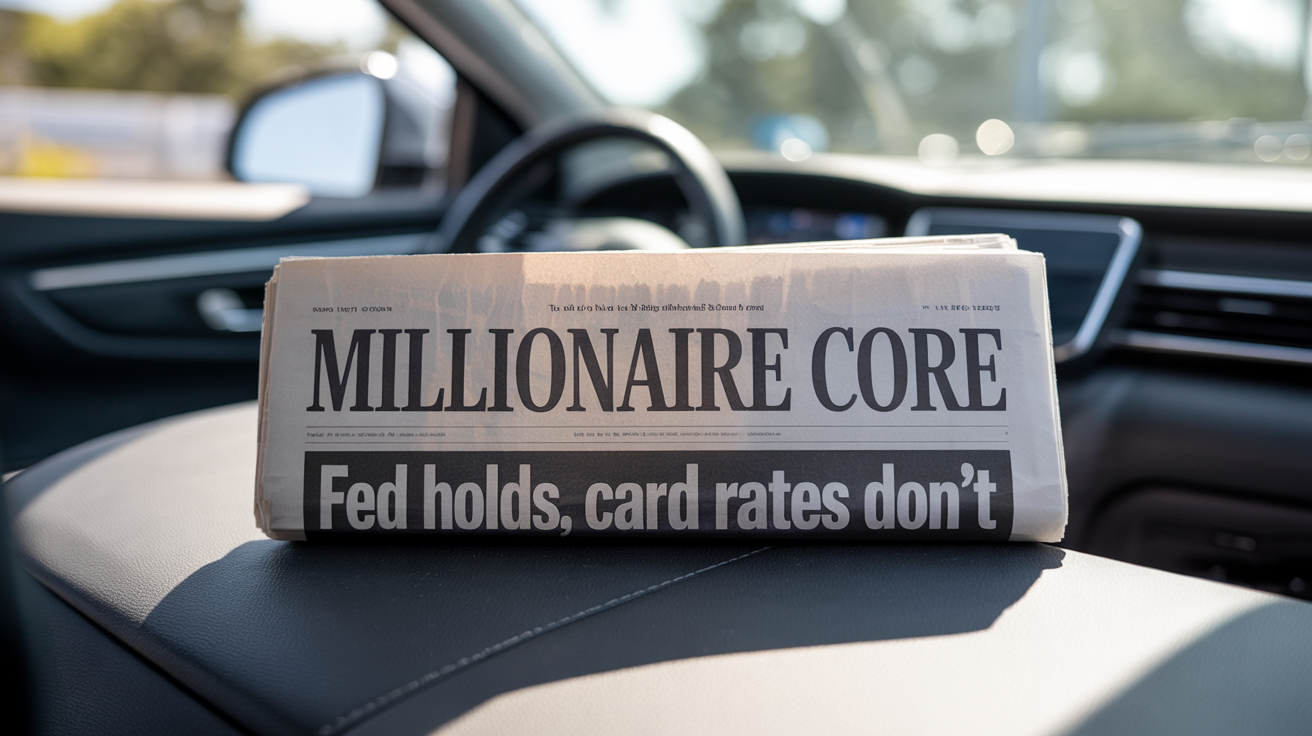
The Federal Reserve just left interest rates unchanged for the fifth meeting in a row, holding its benchmark rate at 3.50% to 3.75%. That should be good news for anyone carrying a balance. It is not, because the average credit card rate never moved in the other direction to begin with. It is still sitting near 20%, and depending on which issuer's data you look at, well above that.
Sponsored by Brownstone Research
Putin forced Trump’s hand (RE: “redacted” files)
Dear Reader,
Despite what the mainstream media would have you believe…
Trump didn’t “redact” these files to cover anything up…
And he didn’t do it for any petty political reason…
His quiet maneuver was an emergency response to something Vladimir Putin recently said:
“Artificial intelligence is the future, not only of Russia, but of all of mankind… Whoever becomes the leader in this sphere will become the ruler of the world.”
— President of Russia, Vladimir Putin
That’s why Trump “redacted” these files… because they hold the key for AI dominance.
And I know how crazy that sounds on the surface…
Especially since NPR called the “Redacted Trump Files” both “disappointing” and “concerning”...
But we all know how biased the mainstream media is when it comes to our president…
And after poring through all 750 files myself, I can tell you without a doubt — the mainstream media is wrong again!
And if you have even $1 invested in the U.S. stock market…
Click here to see the shocking truth for yourself…
Because the truth could set you free.
Jeff Brown
Founder & CEO, Brownstone Research
Good investing,
A "Hold" Is Not a Cut
Markets had spent the past week debating whether the Fed might actually hike instead of hold, with futures pricing in as much as a one-in-three chance of a rate increase before the meeting even started. That the central bank chose to stand still instead is being read as a mild relief. But standing still is not the same as easing. The federal funds rate has now been parked at this level for five straight meetings, and none of that stability has trickled down into what banks charge on revolving balances.
Card Rates Move on Their Own Schedule
Credit card APRs are loosely tied to the prime rate, which tracks the Fed's benchmark. In theory, a steady Fed should mean a steady card rate. In practice, issuers have kept margins wide since the last cutting cycle, and the average rate across major card databases still runs anywhere from the high teens into the mid-20s depending on your credit profile and card type. A cardholder carrying a balance today is paying close to what they were paying a year ago, Fed decision or not.
Inflation Is the Real Reason Nothing Moves
The Fed's own language this week leaned on inflation concerns to justify sitting still, with policymakers pointing to price pressure that has not fully cooled. Energy costs and a more hawkish tone from some officials kept a hike on the table right up until the vote. That backdrop matters for household budgets in two ways: it keeps borrowing costs elevated, and it keeps the Fed in no rush to hand back relief on the assumption that inflation is fully tamed.
Chip Stocks Wobbled While the Fed Talked
While the Fed met, a separate story played out in equities. A fresh sell-off in semiconductor names pressured the Nasdaq as investors grew nervous about whether heavy AI-related spending by big tech can keep paying off. The S&P 500 slipped alongside it. None of that volatility changes what is happening in a household budget, but it is a reminder that a shaky stock session and a steady Fed decision can arrive in the same week without canceling each other out.
Final Take
A held rate sounds like stability, and for the broader economy it probably is. But stability at 3.50% to 3.75% is not relief if you are carrying a card balance at a rate several times higher. Nothing in this week's decision lowers that number. Until the Fed actually cuts, and until card issuers pass a cut along instead of quietly protecting their margins, the smartest move for anyone with revolving debt is the one that does not depend on the Fed at all: pay down the balance faster than the rate is working against you.
Written by Deniss Slinkins
Millionaire Core
Trump and Elon are BACK (Sponsored by InvestorPlace Media)
Trump’s $3 Trillion Reset (Sponsored by Porter & Co.)
TRADE ALERT: “Accelerated AI” stocks are breaking out (Sponsored by Brownstone Research)
Elon's Next Move Could Be His Greatest Yet (Sponsored by InvestorPlace Media)