
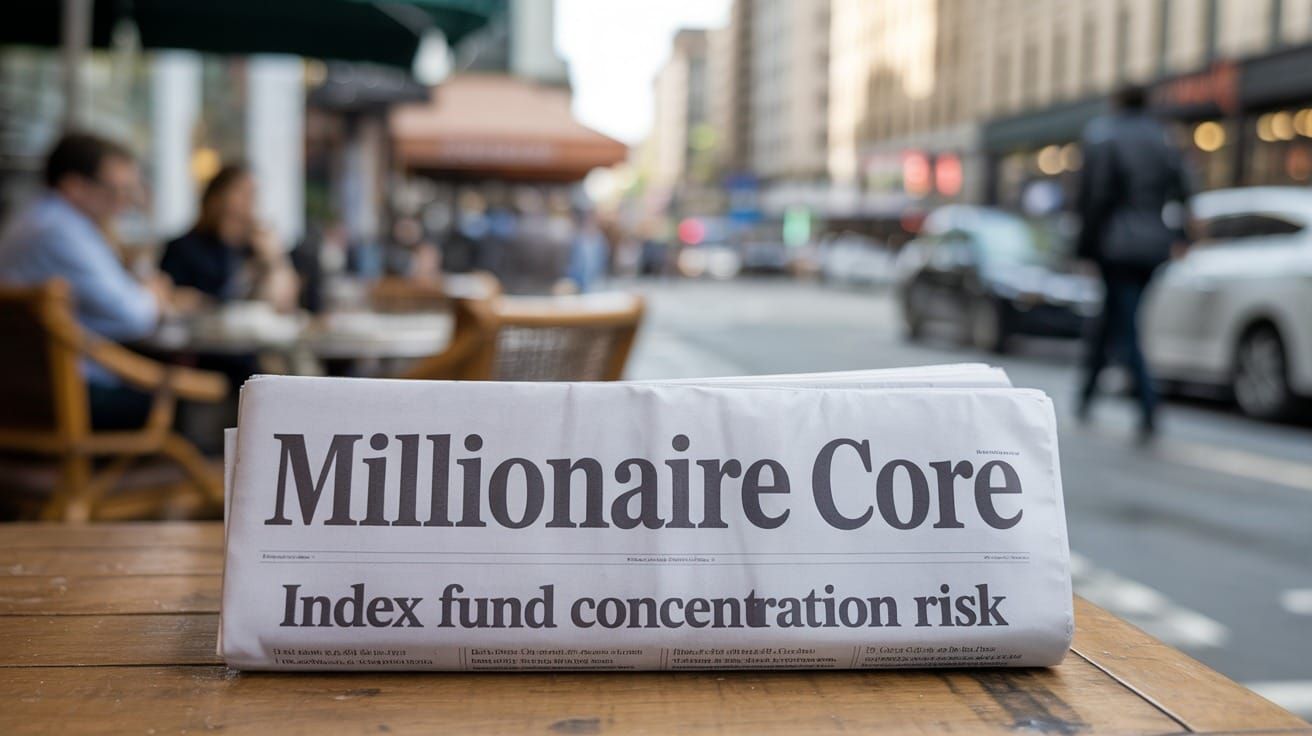
Ten companies now make up roughly 38% of the S&P 500. Nvidia, Apple, Alphabet, Microsoft, Amazon, Broadcom and Meta sit near the top of that list. If your retirement account holds a standard S&P 500 fund, which most American retirement accounts do, then nearly four dollars of every ten you own are riding on the same handful of technology businesses. The word on the fund fact sheet is diversified. The math says something narrower.
How the Index Got This Top-Heavy
An S&P 500 fund is weighted by market value, not by company count. That is not a flaw, it is the design. When a company grows, its share of the index grows automatically, and nobody has to make a decision.
The result is that a decade of technology outperformance has quietly rebuilt the index into something closer to a large technology fund with 490 supporting characters. The S&P 500 hit an intraday record near 7,815 in August, and the names doing most of that lifting are the same names that were doing it three years ago.
The Part Nobody Expected
Here is where it gets interesting. Concentration is at a record, and the concentrated version has been the weaker performer this year.
Through the end of July, the equal-weight version of the S&P 500 returned 13.2%. The standard cap-weighted index returned 9.4%. Mid-cap and small-cap value strategies did better still. In other words, the average stock in the index has been beating the index, which only happens when the biggest names are lagging.
That is not a prediction of a crash. It is a reminder that the concentration everyone worries about cuts both ways, and this year it has been quietly costing cap-weighted investors a few points of return rather than delivering them.
What This Means for a Retirement Account
Most target date funds and workplace 401(k) menus lean heavily on cap-weighted US large-cap exposure. That has been a very good default for fifteen years. It is also a bet with a specific shape, and the shape has gotten more pronounced, not less.
The risk is not that technology is a bad business. It is that a portfolio can end up with far more of its outcome tied to one sector's earnings than the owner ever consciously chose, and discover it during the year those earnings disappoint rather than before.
Final Take
This is not a case for selling anything. Index funds remain the cheapest and most reliable way for most households to own American business, and market timing based on concentration statistics has a long record of failure.
It is a case for opening your statement and actually looking. If your account is one S&P 500 fund, you own roughly 38% in ten companies. If that number surprises you, that surprise is the useful information, not the number itself.
The fixes are ordinary and available in most plans. An equal-weight fund, a mid-cap or small-cap allocation, or an international sleeve all reduce that top-ten concentration without leaving the index approach behind. Whether you want to make that change is your call. But it should be a call you made, rather than a position the index built for you while you were not watching.
Written by Deniss Slinkins
Millionaire Core